


Alexander Archipenko (1887-1964)
Code: 10699
Dimensions:
Alexander Archipenko (1887-1964)
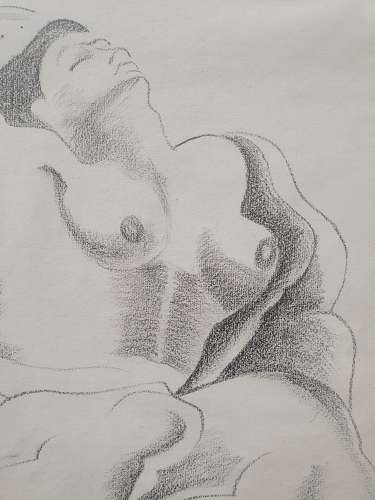
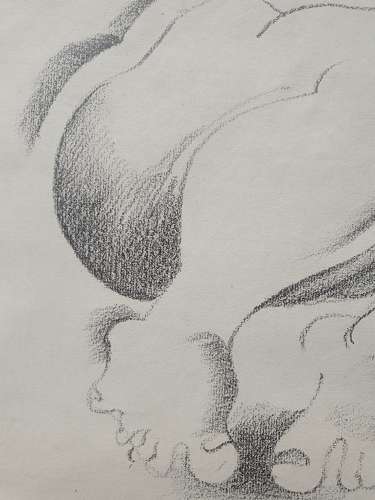
Reclining Female Nude c.1920
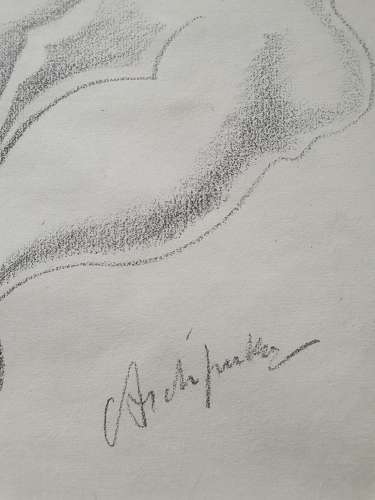
Graphite on paper, signed.
Provenance : Christies New York, Modern and impressionist sale Sept 2008 Lot 61.
Christies state that the work was authenticated by the Archipenko Foundation.
This drawing is study for a rare lithograph by Archipenko of the same subject dated to 1920. In his book, Archipenko, The Sculpture and Graphic Art by Donald H Karshan 1974. Karshan describes the lithograph, 'The use of repeated contours or echo systems is particularly evident on the right and left sides of this heavy female torso - made even more robust by the extended and highly activated patterns. Michelangelesque in its massivness and upswept limbs and neck, the conception reminds us that Archipenko, as a child in Kiev, copied the Italian masters work from a book given to him by his grandfather, an icon painter, "Reclining Female Nude", of circa 1920, appears to be a preniminary study for this print. In the sculpture "Reclining" of 1922, Archipenko used a similar motif but smoothed down the forms of the body into a more serene pose.' (Page 79)
This is a large drawing which fills the sheet, it is in bold contrast which effects a striking image from a distance. The female form was key to Archipenko's work, whether shifted into cubist shapes, flattened or distorted, his artwork still remained rooted in a female form.
Archipenko was a seminal figure in 20th century sculpture, along with the French-Hungarian sculptor Joseph Czasky they exhibited the first public cubist inspired sculptures in Paris at the Salon des Indépendants and Salon d'Automne, 1910 and 1911. Archipenko departed from the classical sculpture of the period, using faceted planes and negative space to create a new way of looking at the human figure, often showing a number of views of the subject simultaneously. He introduced sculptural voids, and devised 'sculpto-paintings', reliefs with collage early in his career.
Born in Ukraine he studied in Kiev and after a short move to Moscow he settled in Paris in 1908. In 1914 he moved to Nice where he stayed until 1920 and the following year moved to Berlin where he opened an art school.
In 1923 he migrated to the USA and became a citizen in 1929, where he remained there until his death in 1964.
Archipenko is represented in museums and collections worldwide, a full list and biography are available on the Archipenko Foundation website, archipenko.org